What the Discard Pile Knows: A Cautious Study of Peach Pits and Leaves

Photo: DONOSTIA KULTURA, CC BY-SA 2.0, via Wikimedia Commons
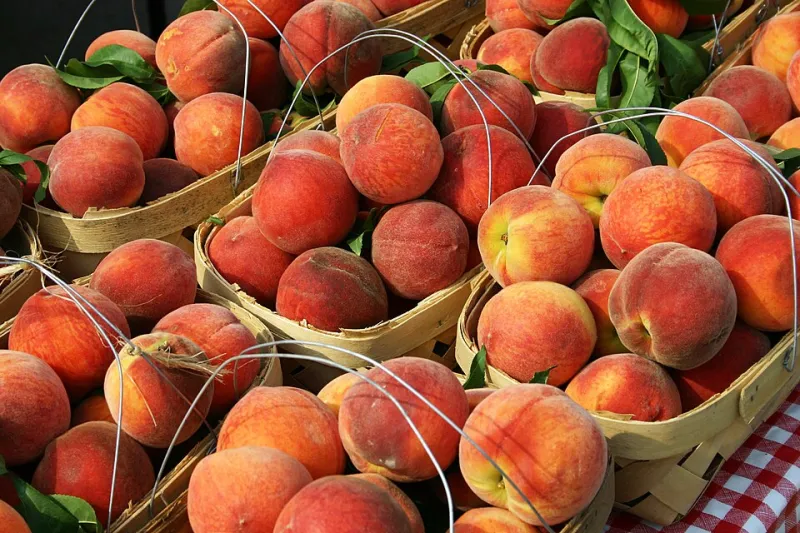
Late November is the season of the discard pile. The last peaches of 2026 have been eaten, the farmers market has gone quiet, and on the counter sits a bowl of pits. In many American kitchens this bowl would go straight to the bin. In our juku, it stays out for a day or two, not because we intend to cook it, but because we intend to look at it.
A peach pit is the part everyone throws away, and it is also the part that teaches the first lesson of peach study: curiosity without recklessness. The Japanese kitchen tradition I was trained in does not ask students to use every last scrap. It asks them to pay attention to every last scrap, and then to decide, with care, what belongs in the pot and what belongs in the compost.
The Pit Is Not a Scrap
The pit is a seed, a stone, a hard echo of the fruit. It is also a carrier of amygdalin, a cyanogenic glycoside found in peach pits, bitter almonds, and related stone fruit. When the pit is crushed or chewed, enzymes and gut bacteria can release cyanide. This is why peach pits are never eaten, why the kernels inside them are not a home snack, and why a juku lesson begins with a simple statement: the pit can hurt you.
That statement is not a warning tacked onto the end of a recipe. It is the foundation of the study. A cook who understands the risk can handle the pit with respect. A cook who ignores the risk is not being adventurous; they are being careless.
In Japanese home cooking, the pit has often been treated as a scent material and a marker of the season rather than as food. I have seen old household notes that call for a whole pit to be added to poaching syrup for aroma, and I have seen instructions for scenting vinegar with pits. I understand the impulse. The pit carries a faint almond-green smell that seems to promise something. But this school does not issue those notes as recipes.
Syrup, Vinegar, and the Limits of Folk Method
The reason is not fussiness. It is toxicology. A whole pit may contribute scent to a liquid, but it also raises a question no home cook can answer with a taste test: how much amygdalin has moved into the syrup? The prudent answer is not to serve it. The same applies to pit-infused vinegar. Acidity does not neutralize cyanogenic compounds, and a pretty jar on the shelf is not evidence of safety.
Peach-leaf tea belongs in the same careful category. In Japanese folk tradition, dried peach leaves were sometimes used in preparations and teas, and the image has a certain pastoral charm. Modern guidance does not support drinking peach-leaf tea casually. The leaves contain cyanogenic compounds, and the folk tradition is not a license to ignore that fact. At Momoiro Tomejuku, we study the leaf as history, not as a beverage.
This is where American readers often expect the pivot: surely there is a safe way to use the pit? There is a safe way to study it. There is not a safe way to pretend it is a spice.
A Safety-First Study Station
A juku study of the discard pile can be honest and still be useful. Set out three small stations. At the first, place whole pits in a closed glass jar with no liquid. Label the jar clearly: not food. Open it briefly to observe the scent, then close it. At the second, make a simple ink print of a pit on paper, noting its ridges and weight. At the third, keep a compost container. The pit can return to the garden or to municipal compost according to local rules, but it does not return to the plate.
There are rules for this station. Do not crack the pits. Do not crush them. Do not taste the kernels. Wash your hands after handling. Keep the bowl away from children and pets. If a pit has split, treat it as a curiosity, not a culinary ingredient, and discard it. These rules are not an insult to tradition. They are the tradition at its most responsible.
What Respect Looks Like
Mottainai is often translated as wastefulness, but in the juku it is closer to a habit of attention. The point is not to eat every part of the fruit. The point is to notice what the fruit has given and what it has withheld. The pit withholds. It says: here is the limit of the recipe.
That limit is worth teaching. In the United States, we are trained to see a discard pile as a failure of thrift. A juku sees it as a place of study. The pit becomes a lesson in labeling, in hand-washing, in keeping a clean counter, and in refusing to let enthusiasm outrun knowledge.
When the bowl is finally emptied, the pit does not leave behind a recipe. It leaves behind a question: what else have I been throwing away without looking at it? That question is the beginning of peach study. The answer is not always a dish. Sometimes it is a compost bucket, a labeled jar, and a cook who has learned to respect what can hurt them.