Three Peaches, Three Teachers: Reading Elberta, Cresthaven, and White Lady as a Syllabus

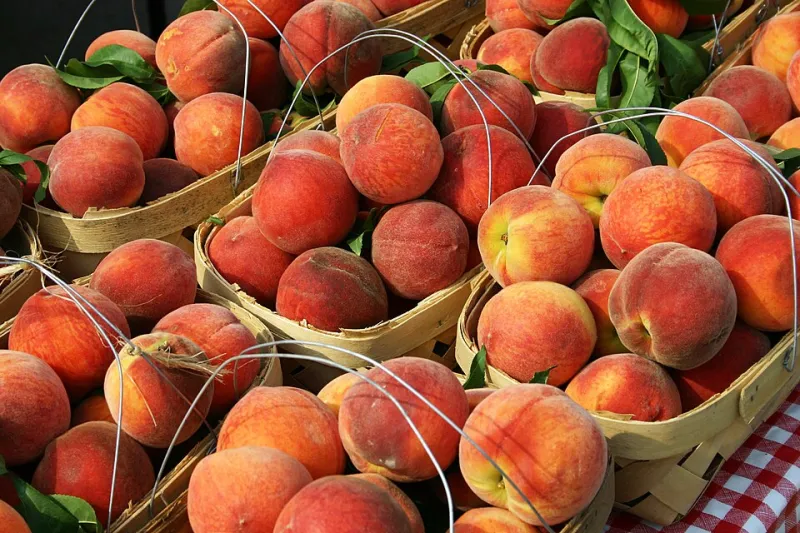
Photo: fresh peach varieties arranged on wooden tasting board with knife, via image.winudf.com
A peach does not arrive in the kitchen as a blank slate. Elberta carries a century of American orchard history in its blush; Cresthaven arrives with a certain spine; White Lady seems to ask, quietly, to be handled before it dissolves. To set three such fruits on one board and taste them in order is not indulgence — it is curriculum. Acidity, fiber, aroma, and the speed at which juice runs are the variables every student must eventually learn to read, and each of these cultivars exaggerates one of them enough to make the lesson legible.
Why Three Fruits Teach More Than a Dozen
A flight of twenty varieties produces enthusiasm and very little memory. Three produces comparison. In Japanese home teaching, the idea of shun — the brief window in which an ingredient is at its peak — is rarely conveyed through description. It is conveyed by eating the same thing often enough to notice what shifts. Three cultivars tasted side by side accomplish something similar in a single sitting: they make the ordinary strange, and therefore teachable.
Students who begin with a field guide rather than a recipe tend to develop vocabulary faster. They stop saying “good” and start saying “sharp at the back of the throat” or “soft center, no grip.” That vocabulary is the real equipment of the kitchen. Everything that follows — seasoning, heat, timing — depends on it.
Elberta: The Generous Generalist
Introduced in 1870 by Samuel Rumph in Marshallville, Georgia, Elberta became the reference point against which many American peaches were judged for the better part of a century. It is freestone at maturity, yellow-fleshed, generously perfumed, and carries enough acid to keep its sugar from collapsing into monotony. It is a peach that forgives a hesitant hand.
- The lesson: balance of acid and sugar.
- The exercise: taste one slice of Elberta beside one slice of a low-acid white peach and note where saliva gathers. Acid announces itself at the sides of the tongue; sugar rounds the finish. Write one sentence about each.
- The kitchen use: eating fresh, cobbler, and — best of all — slices macerated for ten minutes with a bare pinch of fine salt, which draws aroma forward without adding sweetness.
Cresthaven: The Teacher of Structure
Cresthaven, a Michigan Agricultural Experiment Station introduction of the early 1950s, is the firmest of the three in the hand. Its flesh holds its edge under heat, its fuzz is moderate, and its tang is more insistent than its perfume. Where Elberta teaches balance, Cresthaven teaches architecture.
- The lesson: texture as a separate axis from flavor.
- The exercise: cook a single slice of each peach in a covered pan with a tablespoon of water for two minutes. Lift the lid and observe. Cresthaven keeps its shape; the others begin to surrender theirs. Neither result is failure — but knowing which will happen is competence.
- The kitchen use: grilling, poaching in syrup, and folding into a compote that should still read as fruit rather than jam.
White Lady: The Lesson in Restraint
A white-fleshed introduction from California breeding, White Lady is low in acid, high in floral aroma, and quick to bruise. Chilled, it goes quiet; served at room temperature, it opens. It is the cultivar that most reliably teaches a student to stop handling the fruit.
- The lesson: aroma precedes sweetness; delicacy is not blandness.
- The exercise: taste one slice cold from the refrigerator and one at room temperature, fifteen minutes apart. Note how much of what you called flavor was actually temperature masking perfume.
- The kitchen use: served plain and cold-poached in a light syrup, or sliced over nothing at all. This is a peach that does not require rescue.
A Tasting Sequence for One Sitting
Set all three on a plain board. No sugar, no cream, no crackers — those are instruments for later lessons.
- Smell first. Note the distance at which each fruit announces itself.
- Press gently at the shoulder, near the stem, not the cheek.
- Slice from stem to tip and look at the pit: clingstone or freestone, and how much flesh clings.
- Taste in order of aroma, from quietest to loudest.
- Wait two minutes between fruits. Water, not coffee, between tastes.
- Write one line each — not a rating, an observation. Ratings close inquiry; observations open it.
Matching Fruit to Exercise
A practical shorthand for the home kitchen:
- Knife practice: Cresthaven. Its firmness makes an even slice achievable and makes an uneven one obvious.
- Syrup preservation: Elberta. Its acid holds color and keeps the jar from tasting flat.
- Fresh service: White Lady. The less you do, the better the result.
- Compote: Cresthaven for texture, Elberta for depth; a mix of the two is better than either alone.
- Freezing: Elberta, sliced and packed with a little lemon, holds aroma longest.
Questions Worth Asking at the Stand
Cultivar names are less useful than they appear on a label, because a well-grown Cresthaven will outperform a poorly handled Elberta every time. Ask instead: When was this picked? Is it freestone right now? What is peaking this week? A grower who answers with specifics is a grower whose fruit will teach you something.
What the Board Leaves Behind
The three peaches will be gone in twenty minutes. The notes should not be. Keep them — a single card per cultivar, dated, with the weather, the stand, and one sentence about how the fruit behaved. Across a season, those cards become a syllabus written by the fruit itself.
Do not ask which peach is best. Ask what each one is willing to teach, and whether you were paying attention when it said so.