The Teacher's Apron: What I Wore, Brought, and Left Behind on My First Day of Peach Study
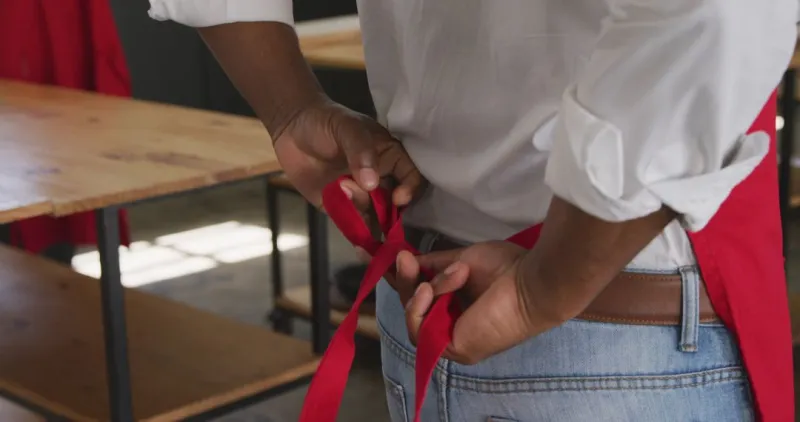
Photo: person tying linen apron in bright kitchen preparing fruit, via pikwizard.com
The morning I left for my first formal session of peach study, I stood in my kitchen in Ohio holding a canvas apron I had not yet decided to wear. It was stained from years of weeknight dinners — tomato sauce, turmeric, one memorable incident with blueberry compote. I had assumed it would do. My teacher, a soft-spoken woman who had studied traditional fruit preparation in Yamanashi Prefecture before settling in the United States, disagreed. Not unkindly. She simply asked me what I intended to learn that day, and whether my apron had been chosen to help me learn it or merely to keep me clean.
The question has stayed with me for years, and it is the one I now offer to every new student who arrives at our study table: preparation is not logistics. Preparation is the first lesson.
Dressing for the Work the Fruit Demands
In Japanese culinary training, what you wear is treated as part of the practice. The uniform exists not for appearances but for function and focus — it signals to the body that it has entered a different mode of attention. A juku student ties on the apron the way a calligrapher grinds the ink: slowly, with awareness.
Peach work has particular demands. The fruit is wet, fragrant, and unforgiving of haste. Juice runs down the wrist. Skin slips under the blade. Sugar syrups spatter. I recommend a heavy cotton or linen apron with long ties that wrap fully around the waist and secure in front — no loops that catch on drawer handles, no dangling scarves near the cutting board. Sleeves should roll above the elbow. Hair belongs back, not because of appearance but because a stray strand in a delicate preserve is a small failure of care.
Choose something you can stain without grief. A pristine apron at the end of a peach session usually means the student held back.
What Belongs in the Bag
Over time I have settled on a modest kit, and I encourage new students to assemble their own rather than buy one. The act of choosing each item is itself a study of what the work requires.
- A sharp paring knife, honed the night before. Dull blades bruise the fruit and teach impatience.
- A clean cotton cloth, folded in thirds, for hands and board.
- A small notebook and pencil, never a phone. Juice and screens are natural enemies, but more importantly, the hand that writes remembers differently than the hand that photographs.
- A shallow container with a lid, in case the day ends with fruit to carry home respectfully rather than leave behind.
- A small token of intention. Mine, that first day, was a peach pit from the tree in my grandmother's backyard in Georgia, kept in a tin for a decade. It has no practical function. That is precisely the point.
The token deserves mention. In traditional study, ritual objects are not superstition; they are anchors. When the session grows difficult — and it will, because repetition is the curriculum — the object recalls you to why you came. Bring something small and quiet. Leave the phone in the car.
What I Left Behind
The heavier preparation is subtraction. Before my first day, my teacher asked me to name my assumptions about peaches, and I produced a confident list: that riper is always better, that sweetness is the goal, that a recipe is a set of instructions. She listened, nodded, and said only, "Leave them at the door with your shoes."
This is the part I now emphasize with every incoming student. Arriving with a full mind is the most common obstacle to learning. The home cook who believes she already knows how to cut fruit will not notice the difference between a cut that respects the flesh's grain and one that merely divides it. The student who arrives empty-handed in spirit — curious, slightly uncertain, willing to be corrected — receives everything.
Concretely, I suggest writing down three assumptions about peaches or about your own cooking, folding the paper, and leaving it at home. It sounds ceremonial because it is. Ceremony, in the juku tradition, is simply attention given a visible form.
Setting the Intention Before the First Cut
In Japan, students at traditional schools often begin with a brief moment of stillness — a bow, a settled breath, a silent statement of purpose. Translated to an American kitchen, this need not be mystical. It can be thirty seconds at the counter before you wash your hands: Today I am learning how the knife meets the fruit. Nothing more.
The narrowness matters. My first session was devoted entirely to one thing — the proper halving of a peach around its pit, using the natural seam, with a twist rather than a pull. I had done this casually for thirty years. I did it formally, badly, then less badly, perhaps forty times that morning. By noon my hands smelled of peach and my notebook held three sentences. It remains among the most satisfying mornings of my cooking life.
The Apron, Reconsidered
I never did wear the tomato-stained apron to study. I bought a plain indigo cotton one, heavy enough to stand up on its own when folded, and I keep it folded on a hook by the kitchen door, reserved for study alone. When I tie it, something in my posture changes. The weeknight cook recedes; the student arrives.
That is the quiet argument of this piece: the boundary between casual cooking and disciplined learning is drawn not by talent or equipment but by the deliberate things you do before you begin. Choose the garment. Pack the bag. Name the intention. Leave the assumptions at the door.
The peach will do the rest. It has been waiting, after all, for exactly this kind of attention.