A Corner of Quiet: Designing Your Own Peach Study Nook in an American Kitchen
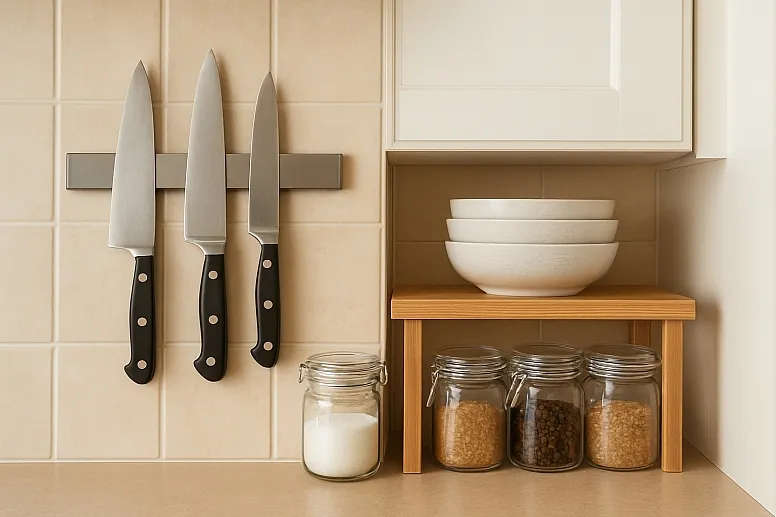
Photo: small minimalist kitchen corner with wooden cutting board knife and notebook on shelf, via www.tastepak.com
There is a particular kind of procrastination that afflicts the American home cook, and it is not laziness. It is diffusion. The peach waits on the counter, the knife waits in the drawer, the notebook waits somewhere in a stack of mail — and because no single corner of the kitchen belongs to the practice, the practice never quite begins.
In traditional Japanese learning, this problem has an old solution: the dedicated place. A juku, or private school, is not merely a curriculum. It is a room, a threshold, a posture. When a student enters, the space itself signals that a different quality of attention is required. What follows is a proposal, drawn from that tradition and adapted honestly for American life: build a small tomejuku corner — a place where peach work is studied, not merely performed.
Why a Designated Space Changes the Work
Culinary students in Japan often speak of the moment they stopped treating knife practice as a chore and started treating it as study. The difference, they report, is rarely a change in technique. It is a change in context. The same hands, the same blade — but now the hands arrive at a place that expects them.
Behavioral research in the United States points toward the same conclusion from the other direction: habits attach themselves to environments. A kitchen counter that hosts homework, mail, and takeout containers cannot easily also host deliberate practice. A corner that hosts nothing else can.
This matters especially for peach work, which is unforgiving in a gentle way. A dull or hurried cut against ripe flesh reveals every inattention. The fruit, in other words, is a fine teacher — but only if you show up ready to be taught.
The Minimal Kit: Three Objects, No More
The temptation, in an American context, is acquisition. Resist it. A traditional study corner is defined by restraint, and the peach requires remarkably little.
A single knife. One small, sharp blade — a paring knife or a compact Japanese fruit knife — kept in the corner itself, not the drawer. Sharpened on a schedule, wiped after every session. The knife becomes the anchor of the space; its condition becomes a quiet report on your practice.
One cutting board. Wood, ideally, for the sake of both the blade and the fruit. Store it upright beside the knife. When it is placed flat on the counter, the session has begun. When it is stood back up, the session has ended. This small physical ritual does more for consistency than any app or calendar.
A shelf of notebooks. This is the element most American cooks will find foreign, and it is the heart of the method. Keep one or two notebooks in the corner. Record what you cut, what the fruit taught you, what failed. Date every entry. Over a single season, these pages become a private curriculum more valuable than any recipe collection, because they record your progress rather than someone else's instructions.
That is the entire kit. A shelf, a knife, a board, a notebook. Total cost, excluding the knife, is modest; total footprint is roughly two feet of counter or wall space.
Placement and Ritual: Borrowing from the Tatami
Japanese study spaces are arranged with intention. The desk faces the room. The tools sit in the same positions every day. Nothing decorative competes with the work. You need not convert your kitchen to tatami to borrow this logic.
Choose a corner with natural light if possible — peach work rewards good eyes — and keep it clear of everything unrelated. If your kitchen is small, a corner of a pantry shelf plus a single hook for the board will suffice. The size of the space matters far less than its exclusivity. One square meter, defended, outperforms a whole counter, shared.
Consider one small ritual of entry. Some practitioners wipe the board and pause before beginning; others read the previous notebook entry first. The specific gesture is unimportant. What matters is that it marks a threshold. In a house full of interruptions — children, phones, delivery drivers — a threshold is not a luxury. It is the only reliable boundary between practice and everything else.
What the Corner Teaches Over a Season
Students who commit to a practice corner report a common arc. In the first weeks, the sessions feel artificial — ten minutes of cutting peach slices that go straight into yogurt or a lunchbox, recorded in a notebook that feels self-important. By mid-season, something shifts. The hands anticipate the fruit. The notebook entries shorten because there is less to correct. And by the end of the peach season, the corner has become the most-used square meter in the kitchen, even for non-peach work, because the habit of arriving has generalized.
This, ultimately, is what a tomejuku corner offers: not a Japanese aesthetic imported into an American kitchen, but an American kitchen given the discipline of a Japanese study. The peach is simply the subject. The lesson is that mastery begins with a place.
When the season ends and the last local fruit has passed, leave the corner standing. Dust the shelf. Sharpen the knife. The notebooks will wait — and next summer, when the first ripe peach arrives from a farm stand or a grocery aisle, you will not be starting over. You will be resuming.