Shun and the American Peach: A Month-by-Month Map of the Season's Truest Moments
Photo: HaJunkiyada, CC BY-SA 4.0, via Wikimedia Commons
In my teacher's kitchen outside Kyoto, the first question asked of any ingredient was never how to cook it, but when. The word for this is shun (旬)—the brief window, often no more than two or three weeks, when a food reaches its fullest expression of flavor, aroma, and texture. A peach eaten within its shun requires almost nothing from the cook. A peach eaten outside it requires forgiveness.
American grocery culture, by contrast, treats the peach as a year-round object, flown in from Chile in January and stored in ripening rooms until it resembles something edible. This guide is offered as a corrective: a map of the American peach's true calendar, region by region, so that home cooks can practice shun on their own soil.
Why Timing Is the First Ingredient
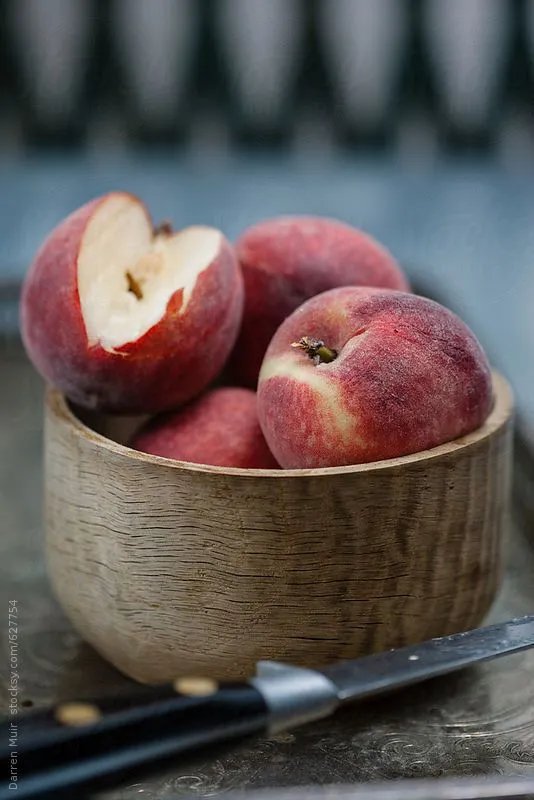
Japanese cooking philosophy holds that the cook's primary skill is not technique but attentiveness. The peach does not announce its ripeness; it offers quiet signals—fragrance at the blossom end, a slight give near the shoulder, a shift from grassy to honeyed in its scent. Learning to read these signs is the domestic equivalent of the tea master's study of the seasons.
When you buy a peach in its regional shun, you receive fruit that was picked ripe, not picked green and ripened artificially. The difference in sugar content, aroma, and flesh structure is not subtle. It is the difference between fruit worth eating and fruit worth preserving—and at Momoiro Tomejuku, we are interested in both.
The American Peach Calendar
The American peach season is a relay race, passed from south to north across four months. Note your region and mark your calendar accordingly.
May — The First Pickings (Georgia, Florida, South Carolina)
Early-season clingstone and semi-freestone varieties arrive in the Deep South. Florida's fruit begins as early as April in warm years; Georgia's famous crop follows in May. These early peaches are best eaten fresh, simply sliced, perhaps with a pinch of salt in the Japanese manner. Their flesh is tender and their season brief.
June — The Deepening (Carolinas, Georgia, Texas)
South Carolina— which grows more peaches than Georgia, despite the older state's marketing—hits its stride. Freestone varieties arrive, meaning the flesh releases cleanly from the pit. This is the moment to begin thinking about light preservation: quick pickles, vinegared peach slices, fruit destined for a week in the refrigerator, not longer.
July — The Height (New Jersey, Pennsylvania, Michigan, Colorado)
The mid-Atlantic and Mountain West reach their shun. New Jersey's orchards and Colorado's Palisade region—high desert days, cool nights—produce fruit of remarkable concentration. July is the month for serious preservation: hang-drying, fermenting, syrup-packing. If you can access only one month of regional fruit all year, make it this one.
August — The Northern Harvest (Washington, Oregon, Idaho, Michigan's later blocks)
The Pacific Northwest carries the season to its conclusion. Washington's stone fruit, benefiting from long summer light, often extends into early September. Late-season peaches tend toward firmness and acidity—excellent for pickling and for cooked applications where the fruit must hold its shape.
Choosing Fruit Worth Your Effort
At the farm stand, conduct your inspection as you would in a Japanese market: with your hands and your nose before your eyes.
- Smell first. A peach worth buying smells like itself—floral, warm, unmistakable. No fragrance, no purchase.
- Press gently at the shoulder, not the belly. The shoulder ripens first; a soft belly often means a bruised interior.
- Ask the grower when it was picked. Tree-ripened fruit should be eaten or processed within days. If the answer is vague, assume it was picked firm.
- Buy seconds for preserving. Orchards sell small, scarred, or irregular fruit at a discount. For fermenting, drying, and pickling, these are not compromises—they are bargains.
A Season, Not a Commodity
There is a Japanese saying: kisetsu no mono wo taberu—eat what the season gives. Applied to the American peach, this means accepting that from October through April, the honest answer is to eat something else, or to open a jar you filled in July.
This is not deprivation. It is the discipline that makes July taste like July. When the calendar reaches your region's shun, clear your counters, sharpen your knife, and give the peach the full attention its short season deserves.