The Top of the Season: Five Essential Peach Lessons Every Student Should Master First

Photo by Photo by Declan Sun on Unsplash on Unsplash
Every juku keeps a short list at the top of the curriculum — the lessons a student should master before moving deeper. At Momoiro Tomejuku, our list is unusually short, because the peach asks for depth, not breadth. Below are the five essentials, drawn from what our students across the United States have found most transformative in their own kitchens.
Lesson One: Read the Peach Before You Touch It
The first skill is not cutting, cooking, or preserving. It is observation. A ripe peach announces itself — a faint fragrance at the blossom end, a gentle give at the shoulder, a soft sound when cupped near the ear. American grocery stores train us to squeeze fruit to death in pursuit of ripeness; the Japanese approach asks for patience instead.
Practice this: hold the peach without pressing. Smell first. Press gently, once, with the pad of the thumb. Then set it on the counter and return tomorrow. You are learning to wait, which is the true foundation of every recipe that follows.
Lesson Two: One Blade, Held Well
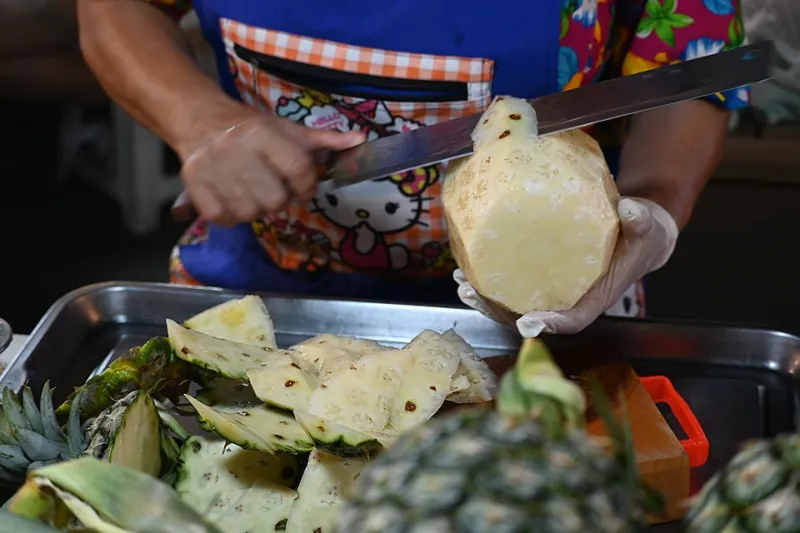
You do not need a Japanese nakiri to cook peaches well, but you do need one sharp knife that you know intimately. In our teaching, the knife lesson comes early because it teaches a larger principle: the fruit should never be forced. Slice along the peach's natural seam, rotate, and twist the halves apart with your hands — the blade's work is nearly done by then.
Care for the knife as part of the lesson. Wash it by hand, dry it immediately, and hone it on a schedule. A dull blade bruises the flesh, and bruised flesh weeps in the jar.
Lesson Three: The Syrup Jar That Leaves the House
The most requested recipe at our school is also the simplest: peaches packed lightly in sugar syrup, the way Japanese home cooks have prepared mizu-shan style fruit for generations. The technique:
- Blanch whole peaches for thirty seconds in boiling water, then shock in ice water; the skins slip away.
- Halve and pit them cleanly.
- Cover with a light syrup — one part sugar to three parts water, simmered and cooled.
- Seal in sterilized jars and refrigerate for at least a week before opening.
The Japanese name for our favorite variation translates roughly as "a jar meant to leave" — because the best batch is always given away. Make a jar for the neighbor down the hall. It is the fastest way a technique becomes a tradition.
Lesson Four: Use the Whole Fruit
Waste is the quiet failure of American peach season. The Japanese kitchen, raised on the principle of mottainai — the regret of letting anything go unused — teaches the whole fruit.
- The skins, left after blanching, simmer into a pale-pink syrup for iced tea or soda.
- The pits, dried on a windowsill, scent a drawer of linens for a season.
- Overripe fruit, too soft for slicing, becomes peach rice or a quick ferment.
Nothing about this is complicated. It is simply attention, applied twice — once at the cutting board and once at the compost bin.
Lesson Five: Honor the Short Season
The final essential lesson is a matter of the calendar. Japanese cooking speaks of shun — the brief window when an ingredient is at its truest. For American peaches, that window runs roughly from late June through August, depending on your state. Georgia and South Carolina peak early; Michigan and Washington later in the summer.
The practice is simple: eat peaches in abundance during the season, preserve a portion of it, and then — this is the difficult part — stop. A peach in October, shipped from far away, teaches your palate nothing. Restraint outside the season is what makes the first bite in June feel like an event.
Where to Go From Here
These five lessons — observation, the knife, the jar, the whole fruit, the season — form the top of our curriculum, but not the end of it. From here, our students branch into ferments, dried peaches, morning rituals, and the quiet ceremonies of serving fruit to family.
Begin with one peach. Master the waiting. The rest of the school will open from there.