Smell First, Then Press Gently: A Farmers Market Lesson Plan for Young Peach Selectors
Photo: Geoff Charles, CC BY-SA 4.0, via Wikimedia Commons
My teacher in Kanagawa had a rule that frustrated me for an entire summer: no student in her kitchen touched a cutting board until they could stand before a basket of peaches, eyes shut, and say something true about one of them. Not something flattering. Something true.
It took me weeks to understand that she was not teaching fruit selection. She was teaching observation as a discipline — the same discipline that would later govern my knife work, my syrup ratios, my patience with the fermenting jar. Observation, she insisted, comes before cooking. Always.
When I returned to the United States, I began wondering how a family might practice this at a Saturday farmers market, where the peaches are heaped in wooden crates and the children are usually tugging at sleeves, asking to leave. What follows is the framework I now share with American families: a weekly lesson disguised as grocery shopping.
The Three Examinations: Fragrance, Weight, Give
Japanese culinary training tends to break large skills into small, repeatable tests. Peach selection lends itself to exactly three.
The fragrance test. A ripe peach announces itself before you see it. Teach your child to hold the fruit near the nose — without squeezing — and inhale at the stem end, where the aroma concentrates. A peach with no scent is a peach with no story yet; it was picked too early and will ripen, but it will never ripen into flavor. A peach that smells like honey and flowers is ready for today.
The weight test. Ask your child to hold two peaches of similar size, one in each hand. The heavier one carries more juice. This is a lesson in density and water content that no textbook delivers as memorably as a palm can. Children grasp it immediately, and they delight in being right.
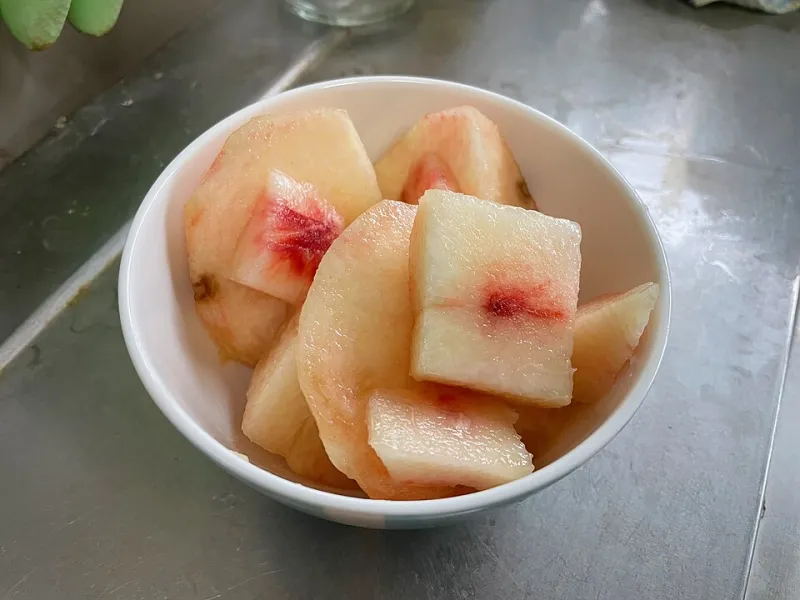
The give test. Press gently with the flat of the fingers near the shoulder of the fruit, never with fingertips, never hard. Firm means days away. Slight give means eat soon. Soft means today, over the sink, leaning forward. My teacher called the overripe peach yasashii — gentle — a word that reframed mushiness as generosity.
A Printable Tasting Chart for the Market
Families I work with bring a simple chart on a clipboard, sized for a stroller tray or a back pocket. Each peach evaluated gets a row. The columns:
- Variety (ask the farmer — this is also a lesson in talking to growers)
- Fragrance (none / faint / strong — circles to fill)
- Weight (light / heavy compared to its twin)
- Give (firm / slight / soft)
- Verdict (buy today / buy for later / pass)
The verdict column matters most. It asks the child to commit to a judgment and then, days later at home, to be held accountable for it. When the too-firm peach they insisted on ripens into something watery and dull, that is not a failure. That is data. My teacher would have said the child has just passed a harder exam than the one they failed.
Why the Slowness Changes the Week
Here is what surprises parents: the lesson does not end at the market. A child who has spent eight minutes smelling and weighing a peach eats differently for the next seven days. They ask which peach was theirs. They notice when it ripens on the counter. They announce, unprompted, that it is ready.
This is the quiet philosophy underneath Momoiro Tomejuku — that attention is a form of cooking, and that a fruit studied carefully is a fruit honored twice: once at the stand, and again at the table. In Japan, the concept of shun teaches that each food has its truest moment, and that finding it requires looking. A child filling out a tasting chart is learning shun without ever hearing the word.
There is also a subtler shift. Children who select food become invested in food. The peach is no longer something that appears in a bowl; it is something they chose, tested, and predicted. Picky eating, in my observation, loosens its grip when the child holds the verdict column.
A Note on Doing It Badly
Your first market lesson will be chaotic. Someone will squeeze a peach too hard and bruise it. Someone will insist a nectarine is a peach. Someone will want to leave. Let all of this happen. My teacher ran the same exercise with adult students, and we were worse than the children — we were embarrassed to smell fruit in public and too proud to admit we couldn't tell one weight from another.
The discipline is not in doing it perfectly. It is in returning next Saturday, clipboard in hand, and smelling first, then pressing gently.