The Night Before: How Preparing a Peach for Tomorrow's Lunchbox Became My Study of Consideration
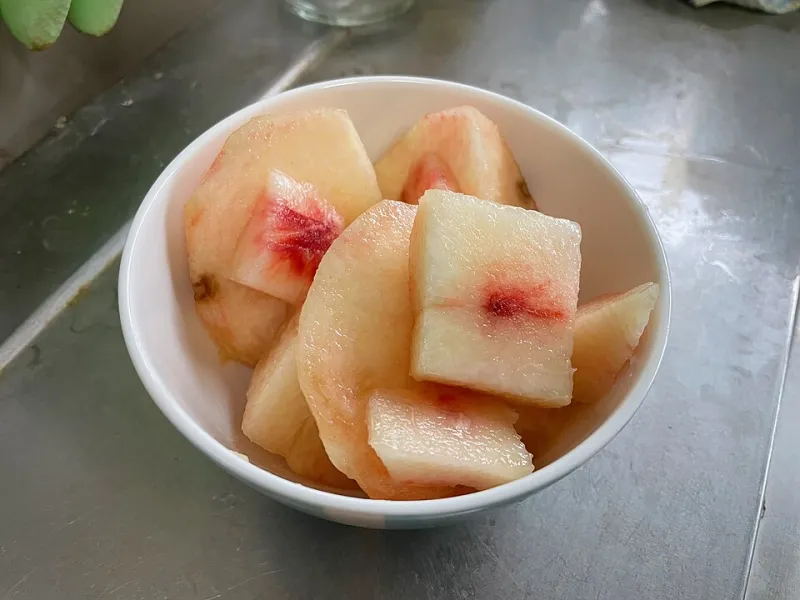
Photo: Kyu3, CC BY-SA 4.0, via Wikimedia Commons
A Test You Cannot See
There is a particular kind of honesty required when you prepare food that will be eaten when you are not present. The cook cannot adjust. The eater cannot ask questions. Whatever you have done — carefully or carelessly — is sealed inside the container until lunchtime.
In my third year of study at a traditional Japanese cooking juku, my sensei assigned what seemed like the simplest task of the entire curriculum: cut a peach the night before, and have it look and taste as though it had been cut that morning.
I assumed it was a lesson in food science. It was not. It was a lesson in what she called omoiyari — consideration — expressed through technique.
Why the Peach Is the Hardest Fruit to Be Kind To
A peach is unforgiving. Its flesh oxidizes within minutes of meeting air, browning from gold to a dull umber that no child, and few adults, will greet with enthusiasm. Its texture is delicate; a dull blade bruises rather than slices. And its juice carries the fruit's aroma, which fades as quickly as its color.
American kitchens tend to solve this problem by avoiding it. We cut fruit at the last possible moment, or we buy pre-cut fruit in plastic clamshells, accepting the trade of quality for convenience. The juku tradition asks a different question: not how do I avoid this work? but how do I do this work so well that the eater never knows it was work?
Three Techniques, Tested in an American Kitchen
1. The Blade Comes First
My sensei's first instruction was not about the peach at all. It was about the knife. A razor-sharp blade severs cells cleanly; a dull one tears them, releasing the enzymes that accelerate browning. I sharpened my knife the way I had been taught — consistent angle, light strokes, testing against the thumbnail — and the difference was immediate. Slices from the sharp blade were still bright the next morning. Slices from a kitchen knife I had neglected were gray by 7 a.m.
2. Acidulated Water, Used Sparingly
The standard American fix is a bath of lemon water. The Japanese approach refines it: a brief dip — thirty seconds, no longer — in cold water with a small amount of rice vinegar and a pinch of sugar. The acid slows oxidation; the sugar rounds the vinegar's sharpness so the peach tastes only of itself. Drain thoroughly and pat dry. Excess moisture is the enemy of a good lunchbox; it turns elegant slices into a sodden puddle by noon.
3. Timing and the Architecture of the Cut
Cut the peach just before bed, not after dinner. Two extra hours matter more than any additive. Cut thick, even slices rather than thin ones — more surface area means more browning. And arrange the slices in the container the way you would serve them: overlapping, in a fan, the way fruit is presented in a Japanese bento. My sensei insisted that the arrangement was not decoration. It was the final gesture of care, the part the eater experiences first.
What the Lunchbox Taught Me
The first morning I did this correctly, my daughter came home and asked why the peach tasted "fresher than usual." She had no idea it had been cut fourteen hours earlier. That, I now understand, was the entire examination.
Convenience culture asks: what is the least effort acceptable? The juku mindset asks: what does the eater deserve? The distance between those two questions is where most of cooking lives. A peach cut the night before, still golden at noon, is a small thing. But small things, done with full attention, are the whole of the tradition I was taught.