Before the First Slice: Why a Sharp Knife Is a Peach Lesson in Itself
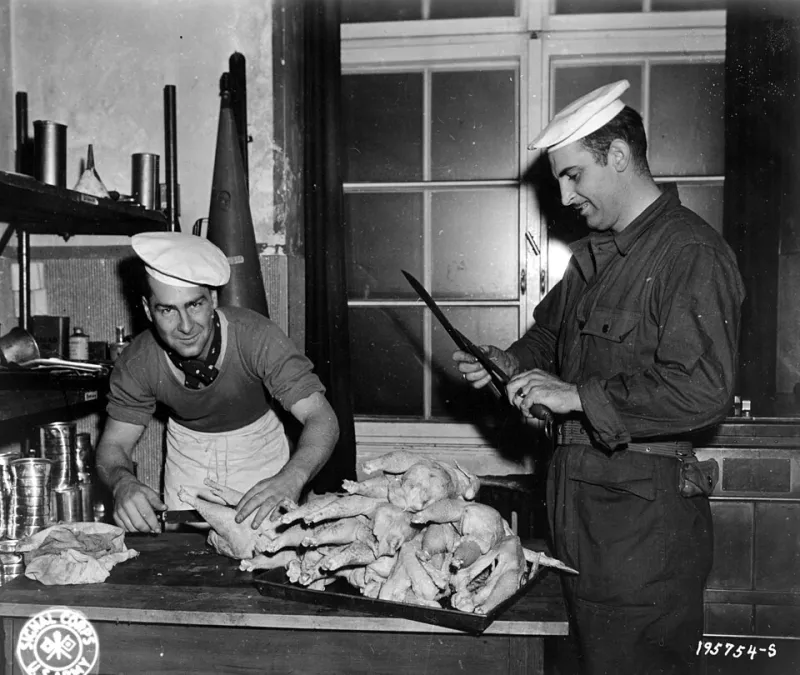
Photo: Signal Corps Archive from United States, Public domain, via Wikimedia Commons
On the first morning of peach study, my teacher did not look at the fruit. She looked at our knives. She asked for each blade, held it under the window, and ran a thumb across the edge with a caution that was itself a lesson. One student had brought a beautiful knife that had never been sharpened. Another had a paring knife from a supermarket block. The teacher handed them back without ceremony and said we would begin with maintenance.
At the time, I thought this was a delay. Now I understand it as the first discipline. A dull knife teaches nothing. It presses where it should part, tears where it should glide, and leaves the cutting board wet with juice that should have stayed in the fruit. Before a student can learn to slice a peach, they must learn what a sharp edge actually does.
What a Sharp Blade Does to a Ripe Peach
A ripe peach is a soft test. It does not reward force. A sharp knife enters the skin with almost no pressure, follows the seam, and leaves a clean face. A dull knife crushes the flesh before it cuts it. The difference is visible in the cut surface: one is smooth, the other is bruised and ragged.
That bruising matters. Bruised flesh releases juice, oxidizes faster, and loses the texture that makes a peach worth eating raw. In a juku exercise, students slice the same fruit with a dull knife and a sharp one, then compare the board. The dull knife always leaves more liquid behind. The lesson is not abstract. The fruit pays for the tool.
A sharp knife is also safer. A dull blade requires more pressure, and more pressure makes a slip more likely. This is especially true with a ripe peach, whose skin can be slippery. The cook who thinks a sharp knife is dangerous has it backward. The dangerous knife is the one that will not cut.
The Beginner's Sharpening Routine
A beginner does not need a drawer full of stones. A 1000-grit water stone is enough to establish an edge, and a 3000- or 6000-grit stone is a useful finish if you want one. Soak the water stone for ten to fifteen minutes, or as the manufacturer directs. Place it on a damp towel so it does not slide.
Mark the edge with a marker if you are unsure of your angle. A Japanese knife is usually sharpened at roughly 15 degrees per side; a Western knife is often closer to 20 degrees. Use light pressure and maintain the angle through the full length of the blade. Work in sections. Ten to fifteen passes per side is a reasonable start. Do not saw violently. Sharpening is a conversation, not a fight.
Finish on the finer stone if you have one, then strop the blade on leather or newspaper to remove the burr. Test the edge on a ripe tomato. If the tomato collapses under the blade, the knife is not ready for a peach.
Honing Is Not Sharpening
A honing rod realigns an edge. It does not restore a worn one. Hone lightly before use, a few strokes per side, and do not overdo it. A pull-through sharpener can remove more metal than a beginner expects, so use one sparingly or not at all. If the knife is damaged, chipped, or badly dull, send it to a professional sharpener. There is no shame in this. There is shame in pretending a rod will fix a blade that needs a stone.
Care Habits for an American Kitchen
Most American kitchens are hard on knives. They sit in sinks, go through dishwashers, and live in blocks where moisture can gather. A few habits will change the life of the tool. Wash knives by hand and dry them immediately. Do not leave them in the sink. Store them on a magnetic strip, in a sheath, or in a block that keeps the edge from touching anything hard. Cut on wood or plastic, never glass. Do not cut frozen food with a delicate peach knife. Oil carbon steel blades lightly, and keep handles dry.
These habits are not fussy. They are the ordinary care a cook owes a tool that does the most intimate work in the kitchen.
Consideration for the Fruit
My teacher inspected our knives first because the knife is the first decision a cook makes about the fruit. It determines whether the peach will be handled or mangled. It determines whether the juice stays in the flesh or runs across the board. It determines whether the student learns patience or force.
Sharpening is maintenance, but it is also a form of consideration. The peach cannot ask for a clean cut. The cook must decide to give one. That decision begins before the first slice, at the stone, with a blade held under the window and a teacher waiting to see whether the student has understood.